User observation & interviews
Qualitative interviews and field observation with your users, customers or employees, surfacing real needs, frictions and workarounds that surveys never catch.
The strongest strategy and the smartest workshop output still fail if they're built on wrong assumptions about your users. With twenty years of UX experience, I bring the research discipline that grounds collective decisions in reality, across customer, user and employee experience (CX · UX · EX).
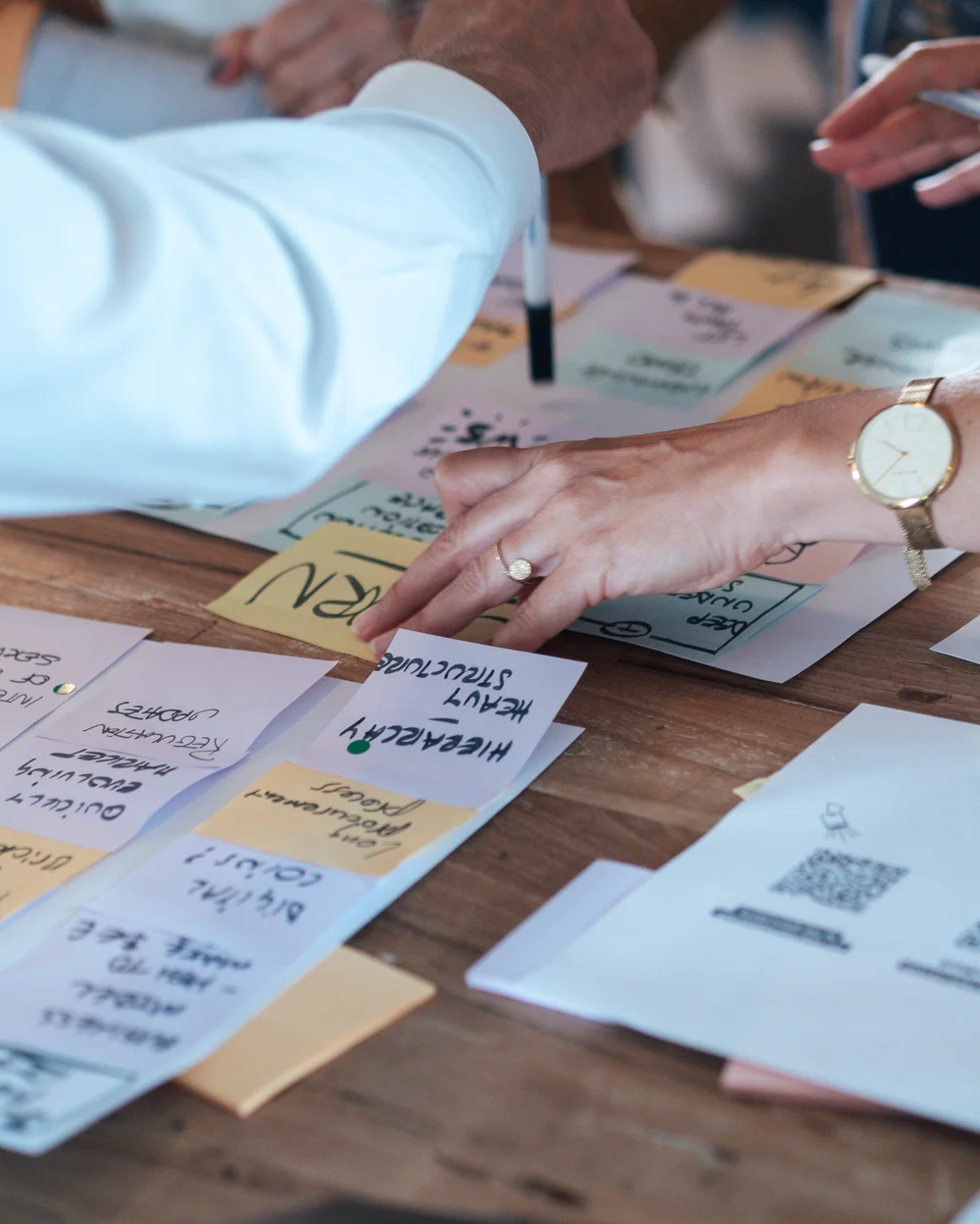
Qualitative interviews and field observation with your users, customers or employees, surfacing real needs, frictions and workarounds that surveys never catch.
Mapping the journeys people actually travel, across the full lifecycle, to reveal friction points, redundancies and gaps between intended and real usage.
Put prototypes, from paper sketches to working products, in front of real users, and learn what works before you invest further.
Value Proposition Canvas, needs collection and strategic framing, connecting what users need with what your organization wants to achieve.
Facilitated group sessions where users and stakeholders react, compare and create: structured to produce honest signals and fresh ideas, not polite consensus.
From research findings to design principles, key journeys and prioritized roadmaps: I coach your team to turn evidence into decisions, not into a report on a shelf.
Research isn't a separate deliverable, it's the fuel of every good workshop and strategy mandate. When stakeholders work from real user evidence instead of assumptions, convergence is faster and the decisions are better.
That's why my strategy mandates typically start with interviews and analysis of the existing situation, and why user-centricity is a design principle in every session I facilitate: the work stays oriented toward the needs of (real) users.
For the État de Genève (OCSIN), the digital strategy for services used by 18,000+ employees started with research: interviews with the managers of the four internal platforms, interviews and observation of selected users, analysis of the four platforms, and mapping of how people actually access information across the lifecycle. The collaborative workshops that followed worked on evidence, not opinions.
Let's find out if it's true, before it gets expensive.
Discuss your research needs